Investing In Englewood: What To Know About Duplexes And Rentals
June 4, 2026
June 4, 2026
If you are looking for a Denver-area investment that feels more attainable than some nearby neighborhoods, Englewood deserves a closer look. You are not imagining the opportunity here: the city offers a meaningful renter base, relatively lower entry prices than some parts of Denver, and zoning that can support duplex and other small multi-unit properties in the right places. At the same time, this is not a market for loose assumptions. You need to understand rents, vacancy, zoning, and the realities of an older housing stock before you buy. Let’s dive in.
Englewood is a mixed owner-renter market, not a one-note rental city. Census data shows 47.7% of occupied housing units are owner-occupied, which helps explain why the city can appeal to both long-term residents and renters looking for access to the broader Denver metro.
That balance matters if you are considering a duplex or small rental property. A market with both owners and renters can create steady demand, but it also means you should evaluate each block and property type carefully instead of relying on broad metro trends alone.
Current rent data suggests Englewood remains a solid rental market, but not one with runaway pricing. Recent trackers place the overall average rent around $1,866 per month, while apartment averages are about $1,550 for a one-bedroom, $2,065 for a two-bedroom, and $2,558 for a three-bedroom. Average house rent is about $2,682.
The bigger story is that rent growth has cooled. Recent data shows rents are down modestly year over year, and local reporting on metro vacancy suggests renters have more choices than they did in the tight post-pandemic stretch. If you are underwriting a deal, it is smarter to assume modest rent growth instead of counting on aggressive annual increases.
For a duplex investor, stable rents can still work well if the purchase basis is right. Englewood may be more attractive as a lower-basis play than as a rapid-rent-growth play, especially compared with higher-priced nearby neighborhoods.
This is where careful math matters. You want to test realistic rents, budget for turnover and repairs, and make sure the property still performs if rent growth stays flat for a while.
Englewood's housing planning documents show a clear affordability strain. The city has said housing prices and rents have risen faster than incomes, about half of renters are cost-burdened, and there is a significant shortage of rental units for households earning under $25,000 per year.
That does not mean every low-priced unit is automatically a great investment. It does mean there is meaningful demand for smaller and more attainable rentals. If you are evaluating a duplex, layout, unit size, and monthly payment range may matter just as much as finishes and design.
In a market with affordability pressure, practical units often have an edge. Features like usable floor plans, in-unit laundry, off-street parking if available, and updated systems can support tenant appeal without pushing your renovation budget too far.
For many investors, the opportunity in Englewood is not building a luxury rent story. It is creating a well-run, well-maintained property that meets real local demand at a sustainable price point.
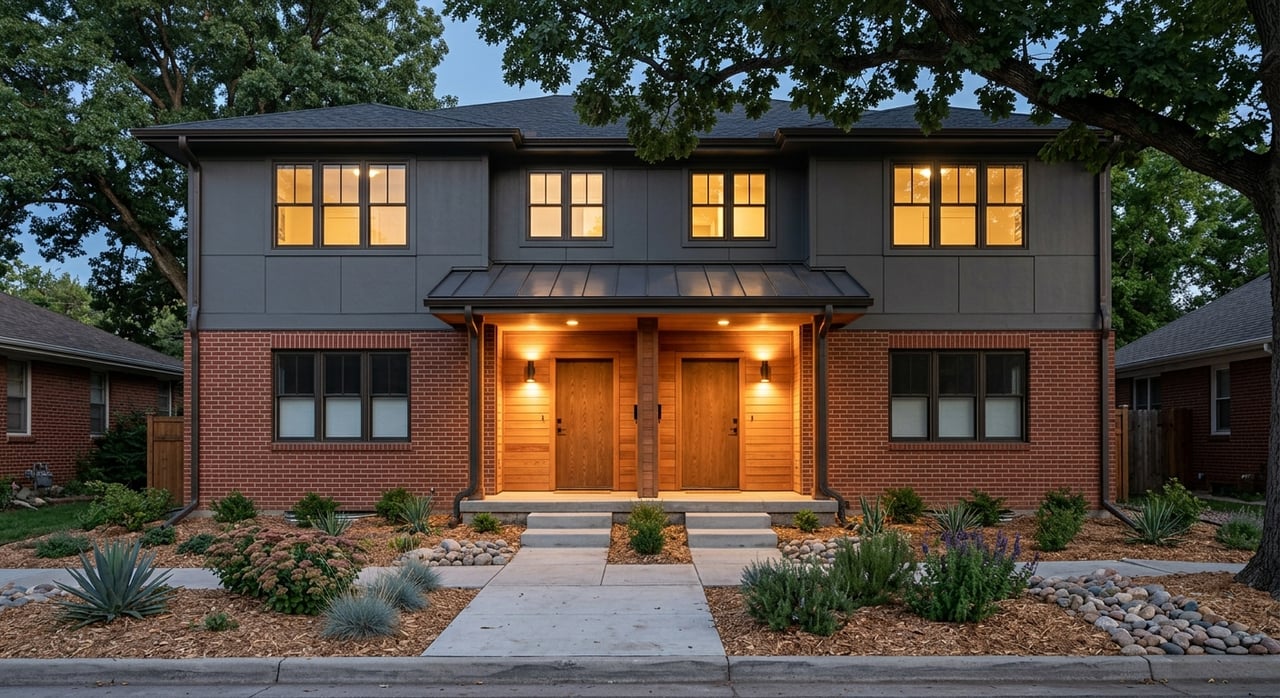
This is one of the most important parts of the conversation. Englewood's 2023 Unified Development Code defines a multi-unit house as a building with two to four principal dwelling units, commonly referred to as a duplex, triplex, or quadplex.
But not every parcel can support that use. The R-1-A, R-1-B, and R-1-C districts are focused on detached-house forms, while R-2-A and R-2-B allow multi-unit houses and attached houses. MU-R-3 districts also allow multi-unit houses, attached houses, and apartment or mixed-use buildings, subject to lot and dimension standards.
If you are shopping for a duplex opportunity, zoning review needs to go beyond the listing description. The actual parcel, district, lot dimensions, and applicable development standards all matter.
That is especially true if you are looking at adding units, reconfiguring an existing structure, or evaluating a property with expansion potential. Englewood also addresses accessory dwelling units separately, with added site, dimension, design, and operation standards.
Englewood has been moving toward broader housing flexibility. The city's affordable housing task force report notes that the updated code includes a wider range of permitted housing types, along with incentives such as extra stories or reduced parking for some projects that include set-aside units for lower- and moderate-income buyers or renters.
For small investors, that signals a city that is thinking actively about housing supply. It does not remove the need for parcel-specific due diligence, but it does suggest a more flexible backdrop than older, more restrictive zoning frameworks.
Englewood's housing stock is relatively mature. City planning data says about 43% of homes predate 1940, and only 10% had been built since 1990. For investors, that can cut both ways.
Older properties may offer value-add potential through renovation, improved operations, or better unit configuration. They can also bring higher maintenance risk, more near-term capital needs, and more surprises during inspections.
If you are considering an older duplex or rental property, pay close attention to:
In a market like Englewood, a property that looks attractive on price can become much less appealing if major systems are nearing replacement. A strong inspection strategy is essential.
On the ownership side, Englewood can offer a more accessible entry point than some nearby Denver neighborhoods. Zillow's current home value index places Englewood at $518,786, compared with $541,899 for Denver overall, $558,159 for University Hills, and $1,184,994 for Washington Park.
That gap is meaningful, even if Englewood is not dramatically cheaper than Denver as a whole. For investors who want metro access without paying premium neighborhood pricing, Englewood can sit in a useful middle ground.
Rent levels show a similar pattern. Apartments.com places Englewood at about $1,550 for a one-bedroom and $2,065 for a two-bedroom, compared with higher figures in University Hills and slightly higher two-bedroom pricing in Washington Park.
The takeaway is straightforward: Englewood is not a bargain-basement rental market, but it may offer a better balance between purchase price and achievable rent than some nearby areas. That can matter a lot when you are targeting a duplex or house-hack strategy.
Vacancy is another reason to stay disciplined. A city energy plan cited a 6.6% housing vacancy rate for Englewood, and metro apartment reporting in 2025 and early 2026 put vacancy in the mid-6% to mid-7% range.
In practical terms, tenants have options. That means landlords may need to compete more on pricing, condition, and responsiveness than they did when supply was tighter.
If you are evaluating a purchase, keep your assumptions conservative. Consider using:
Conservative underwriting does not kill good deals. It helps you identify the ones that still make sense when the market is not doing all the work for you.
Englewood can make sense for several types of buyers. If you want to live in one unit and rent the other, a duplex may offer a more manageable way to enter the market. If you are a long-term investor, the city's renter demand and lower entry cost relative to some neighboring areas can be appealing.
It may also fit buyers looking for value-add opportunities in older housing. The best opportunities are often tied to careful property selection, realistic renovation planning, and a clear understanding of what the zoning actually allows.
Before you move forward on a duplex or rental property in Englewood, focus on the basics:
These steps can help you avoid buying based on a headline or a hopeful pro forma. In Englewood, the best investments are usually the ones backed by local detail and disciplined analysis.
If you are weighing a duplex, rental house, or small value-add opportunity in Englewood, having experienced local guidance can make the search much more efficient. Debbie Niedergerke brings Denver-area market knowledge, hands-on service, and thoughtful property strategy to help you evaluate your next move.
Stay up to date on the latest real estate trends.
Get assistance in determining current property value, crafting a competitive offer, writing and negotiating a contract, and much more. Contact Debbie today to discuss all your real estate needs.